MSHA Standard – June 17, 2024
Effective today is the Final Rule issued by the Mine Safety and Health Administration (MSHA) – Lowering Miners’ Exposure to Respirable Crystalline Silica and Improving Respiratory Protection. MSHA has introduced these new rules to reduce miners’ exposure to respirable crystalline silica, a harmful substance linked to severe respiratory diseases such as silicosis and lung cancer.
Key updates include:
- Lowering the permissible exposure limit (PEL) for respirable crystalline silica from 100 micrograms per cubic meter of air (µg/m³) to 50 µg/m³ over an 8-hour time-weighted average.
- Mandating more rigorous monitoring of air quality in mines.
- Increasing medical surveillance of miners.
- Implementing engineering controls to minimize silica dust.
These changes align with the Occupational Safety and Health Administration’s (OSHA) standards to better protect miners’ health and safety.
In response to these new requirements:
- Mining operations are expected to adopt advanced dust control technologies, such as wet drilling systems and improved ventilation.
- Regular health screenings for miners will now include chest X-rays and lung function tests to detect early signs of silica-related diseases.
- The MSHA will enhance enforcement mechanisms by conducting more frequent inspections and imposing stricter penalties for non-compliance.
These measures demonstrate the agency’s commitment to mitigating the long-term health risks posed by respirable crystalline silica and ensuring a safer working environment for miners across the United States.
Read more from the Department of Labor
OSHA Standard – March 2016
OSHA issued a final rule to combat lung cancer, silicosis, chronic obstructive pulmonary disease and kidney disease in workers by limiting their exposure to respirable crystalline silica. Estimates predict that the rule will save over 600 lives and prevent more than 900 new cases of silicosis annually.
-
Establishes lower (50 μg/m3) permissible exposure limit (PEL)
-
Confirms ISO/CEN criteria of a 4-μm 50% cut-point for respirable dust samplers
-
Aligns OSHA with NIOSH, ACGIH, and several global occupational hygiene organizations
-
Identifies samplers conforming to ISO 7708/CEN criteria can be used
Air Sampling According to the OSHA Standard
Six existing sampling methods are identified in the new OSHA standard with the goal of optimizing the methods to obtain a quantitative limit of detection no higher than 25% of the PEL (based on air volume). A large enough sample is required to reach the detecting limit down to 12.5 micrograms/cubic meter (25% of the new PEL).
The standard recommends modifying current methods to lower the detection level by taking a larger air sample, this accounts for tasks performed for short periods of time.
Applying the formula 1.7 LPM x 60 x 8 hours = 813 L = 0.813 CM you can reach the LDL on some of the methods with the traditional 10 mm nylon cyclone at 1.7 LPM in 8 hours. With a four-hour task it is necessary to double the flow rate by using a medium flow cyclone such as our 4.2 LPM cyclone. Tasks performed for only two hours will require higher flow rates to reach the LDL, by using cyclones such as the 9 LPM RASCAL.
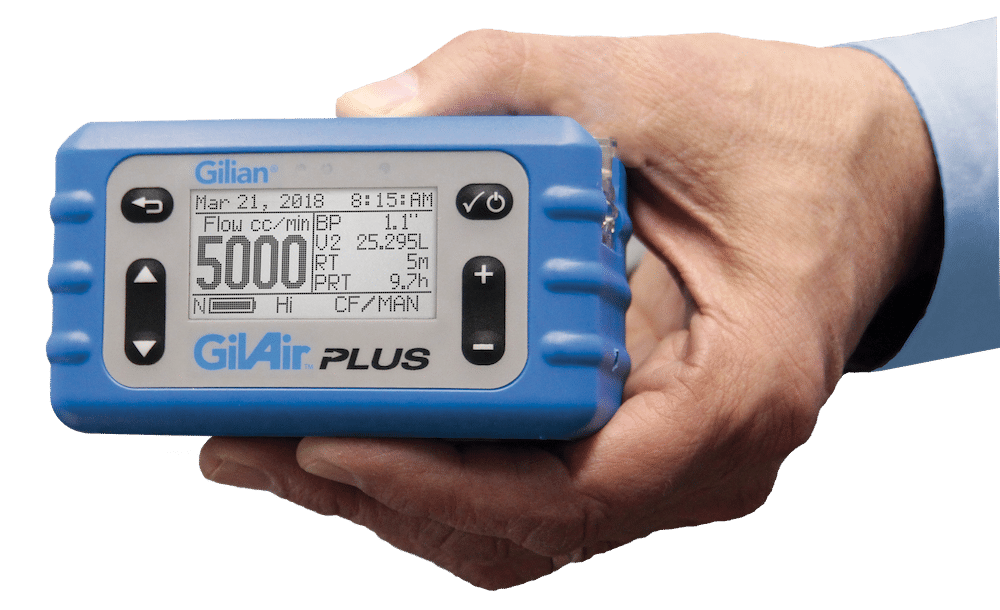
When sampling for shorter periods with a medium or high flow cyclone, larger backpressures are generated and selection of a high flow air sampling pump with high backpressure capabilities is necessary. Sensidyne recommends the Gilian 10i or Gilian 12 for this application.
Silica Sampling Best Practices
- Draw a large enough sample to obtain a maximum limit of detection of 12.5 micrograms per cubic meter (i.e., 25% of 50 micrograms per cubic meter)
- Use the analysis by XRD or IR as described in the six listed methods.
- Observe the cyclone flow rate specification for meeting the ACGIH size selection curve (50% at 4 microns).
- Use a constant flow control pump that will keep the flow rate at +/- 5% of set flow.
- A medium flow cyclone can meet the detecting limit in an 8 hour sample and still be comfortable to wear.
Sampling Methods for Crystalline Silica Exposure
|
Method No. |
Analysis |
LDL (1.7LPM) |
|---|---|---|
|
OSHA ID-142 |
XRD, Redposition |
12.0 μg/m3 (qtz) |
|
NIOSH 7500 |
XRD, Redposition |
6.12 μg/m3 (8 hr) |
|
NIOSH 7602 |
IR, KBr Pellet |
6.12 μg/m3 (8 hr) |
|
NIOSH 7603 |
IR, Redeposition |
12.24 μg/m3 (8 hr) |
|
MSHA P-2 |
XRD, Redposition |
24.48 μg/m3 (8 hr) |
|
MSHA P-7 |
IR, Redeposition |
24.48 μg/m3 (8 hr) |
Sensidyne Cyclone Samplers for Crystalline Silica Exposure
|
Cyclone Model |
Part |
Flow Rate ACGIH |
|---|---|---|
|
10 mm Dorr-Oliver |
800061 |
1.7 LPM |
|
BGI-4L, HD style |
811-9924-01 |
2.2 LPM |
|
Medium flow rate |
811-9926-01 |
4.2 LPM |
|
High flow rate |
811-9925-01 |
8.5 to 9.5 LPM |