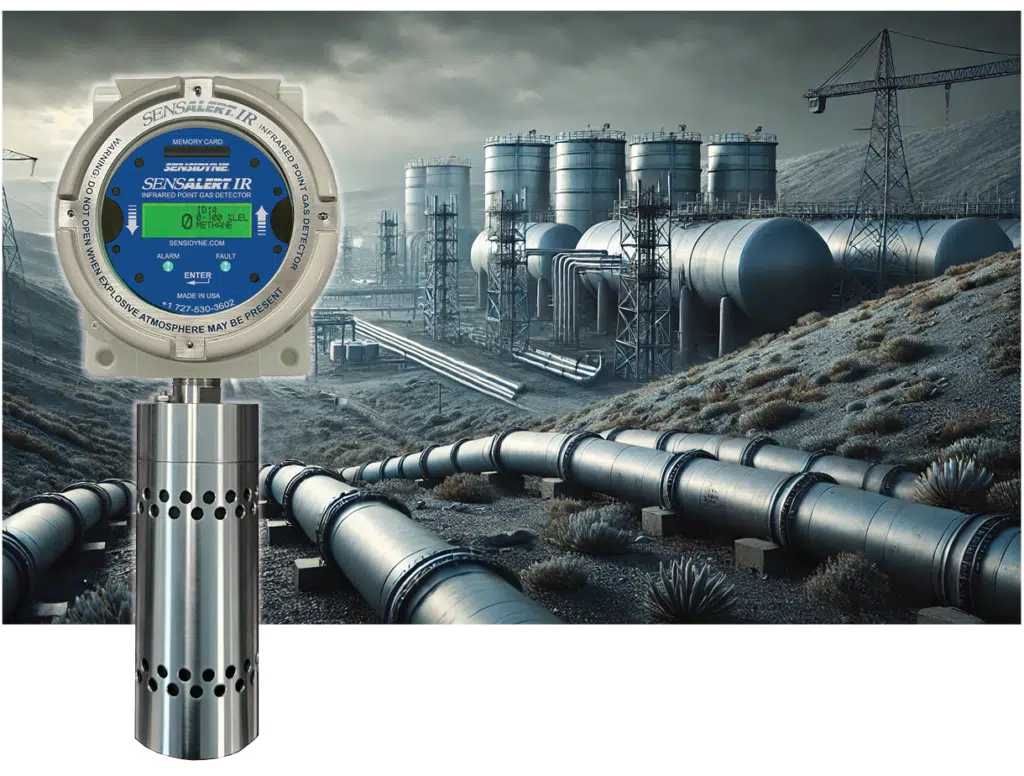
SensAlert IR Infrared Gas Detector

Ultra rugged, explosion-proof infrared point gas detector for harsh, high priority applications–
2-4 weeks lead time!

Product Description


Ideal for remote or hard-to-access environments where high maintenance is not practical.

The fixed point Non-Dispersive Infrared (NDIR) LEL detector is designed for performance in harsh and hazardous Hydrocarbon gas environments. Utilizing solid-state infrared technology, this detector delivers dependable hydrocarbon gas detection with minimal maintenance requirements. The expected lifespan is 10 years.

Sensidyne provides a 2-4 week lead time – not 2-4 months!

Key Features:

  • High Reliability and Durability
    The SensAlert IR has a straight-forward design and rugged 316 stainless steel sensor construction to withstand the most demanding applications.

  • No Routine Calibration and Virtually Maintenance Free
    There is no scheduled calibration programs required for the operation of this instrument and required maintenance is limited to zeroing. You can practically “fire it and forget it,” except for normal periodic testing.

  • Operates in Anaerobic Atmospheres and Constant Hydrocarbon Background
    The self-contained optics fully function in applications where there is no oxygen or hydrocarbons are regularly present. The SensAlert IR optics are also immune to poisoning and etching.

  • Dual Wavelength NDIR Technology
    The sensing and reference elements are self-compensating for optical integrity
    and other signal inhibitors.

  • 3-Wire 4-20 mA Linear Output
    Detectors can be installed in new construction or retrofits using using 3-wires.  Detectors communicate faults and special functions using signals below 4 mA.
  • Dual Infrared Sensors and Remote Mount Capability
    One or two infrared sensors can be mounted locally or remotely up to 250 feet / 76 meters away from the transmitter.

Benefits:


  • Reduced Downtime: Minimal maintenance requirements ensure continuous operation and minimize downtime for calibration.
  • Cost-Effective Operation: The extended lifespan and reduced maintenance needs contribute to a lower total cost of ownership.
  • Enhanced Safety: Reliable detection of combustible hydrocarbons safeguards personnel and assets in hazardous environments.
  • Versatility: The SensAlert IR detector is suitable for a wide range of industrial applications.
  • We offer a 5 year warranty


Common Applications:

  • Chemical Plants
  • Drilling
  • Production
  • FPSO (Floating Production, Storage, and Offloading)
  • Oil Refining
  • Gas Processing
  • LNG/LPG Processing
  • Fire & Gas Applications
  • Loading Racks
  • Compressor Stations
  • Gas Turbines
  • Waste Treatment
  • Electrical Utility Environments

Class 1, Div-1 Rated Infrared Sensors for Combustibles –
316 Stainless Steel and Aluminum Enclosures:

  • Acetone (C3H6O)
  • Butane (C4H10)
  • Carbon Dioxide (CO2)
  • Cyclopentane (C5H10)
  • DF-2000 (CAS 64742-48-9)
  • Diesel No. 1 (CAS 8008-20-6)
  • Ethane (C2H6)
  • Ethanol (EtOH)
  • Ethylene (C2H4)
  • Ethylene Oxide (ETO)
  • Gasoline (CAS 8006-61-9)
  • Isobutane (C4H10)
  • Isopropyl Alcohol (C3H8O
  • Jet A (CAS 8008-20-6 or 64742-47-8)
  • Methane (CH4) – Ethane Immune
  • Methanol (CH3OH)
  • Pentane (C5H12)
  • Propane (C3H8)
  • Propylene (C3H6)

General Purpose Area Infrared Sensors for Toxics –
Aluminum Enclosure:

  • Ammonia (NH3) – Nondepleting
  • Tetrafluoroethane (R134A)
  • Sulphur Hexafluoride (SF6) for:
    • Electrical substations
    • GIS switchgear rooms
    • Utility transmission infrastructure
    • High-voltage equipment rooms
    • Breaker monitoring


NOTE:  The SensAlert IR offers complete functional compatibility as a direct replacement for the discontinued Det-Tronics PointWatch® PIR9400 infrared gas detector.  >>Read about it HERE.

Contact our Experts

Reach out to Our Expert Team for Tailored 
Safety Solutions and Technical Guidance.

Videos

  • Sensidyne SensAlert IR intro video

Product specifications

Sensors

Types – Combustibles

Technology – Infrared

Detection Method – Diffusion

Min. Detectable Change – ± 1 %LEL

Repeatability –  ± 2 % of reading

Accuracy –  ± 3 % LEL, 0 to 50% LEL
± 5 % LEL, 51 to 100% LEL

Response Time (Rise) – T50 ≤ 5 seconds
T90 ≤ 10 seconds

Oxygen Requirement – None

Electrical

Power – 18-32 Vdc, measured at detector
5 Watts max

Termination Resistance – < 500 Ω @ 24 VDC

Outputs – 3-wire, 4–20 mA

User Interface

Controls – Zero

Interface – 4 mA level and activator

Environmental

Temperature –  -40° to 158°F (-40° to 70°C)

Humidity –  0-99 % RH, non-condensing

Enclosure

Transmitter Material – Aluminum

Sensor Material – Aluminum / 316 Stainless Steel

Weight – 7 lbs (3.2 kg) / 10 lbs (4.5 kg)

Ingress – IP54

Approvals

NEC/CEC:
Class 1, Div. 1 Groups B, C & D
C22.2 No. 152-M1984
ISAS12.13.01-2000

Note: Refer to certification documents and datasheets for specific approval and configuration information.

Resources and documents

File type:
All
Catalogs/Brochures (1)
Manuals (3)
Product Datasheets (1)
Sensor Datasheets (3)

FAQ

1. What is NDIR sensor technology?

Dual Wavelength Non-Dispersive Infrared (NDIR) technology is a method used in gas detection sensors to improve accuracy and reliability. Here’s how it works:

  1. Two Infrared Light Sources: The technology uses two wavelengths of infrared (IR) light – a primary sensing wavelength that is absorbed by the target gas and a reference wavelength that is not.
  2. Self-Compensation: By comparing the absorption at these two wavelengths, the system can self-compensate for issues like sensor drift, dirt, moisture, or other environmental factors that might otherwise interfere with the accuracy of readings.
  3. Improved Reliability: This approach provides stable and precise gas readings even in challenging environments where single-wavelength sensors might be affected by signal degradation or interference.
  4. No Oxygen Requirement: Dual Wavelength NDIR sensors, like the Sensidyne SensAlert IR, can operate effectively without oxygen and are less prone to poisoning from chemicals, making them ideal for harsh and hazardous environments.

This technology is especially valuable in industrial settings where consistent, maintenance-free, and accurate gas detection is critical.


2. What are the key advantages of using infrared (IR) gas detection over catalytic bead sensors for detecting combustible gases in this industry?

Infrared (IR) gas detectors, such as the SensAlert IR, offer several advantages over traditional catalytic bead sensors. IR sensors do not require oxygen to operate, making them ideal for enclosed or low-oxygen environments like cottonseed oil storage areas. They also have a longer lifespan, as they are not affected by sensor poisoning or degradation from exposure to combustible gas over time. Additionally, IR detectors require less frequent calibration and maintenance, reducing overall operational costs and downtime compared to catalytic sensors.


3. What are the maintenance and calibration requirements for SensAlert IR, and how does it minimize downtime?

The SensAlert IR is designed for low maintenance, requiring fewer calibration checks than traditional catalytic gas detectors. It features non-intrusive, local calibration, meaning safety personnel can calibrate the unit without needing to remove it from service. The system also includes self-diagnostic capabilities, which alert the user to any sensor drift or faults before they impact performance. With these features, downtime is significantly reduced, and maintenance teams can plan service intervals efficiently rather than reacting to unexpected failures.


4. Does SensAlert IR integrate easily with existing SCADA or control systems, and what communication protocols does it support?

Yes, SensAlert IR is designed for seamless integration with SCADA, DCS, and PLC control systems, making it a flexible solution for industrial safety managers. It supports industry-standard communication protocols, including 4-20mA analog output, HART, and Modbus RTU, ensuring compatibility with most modern monitoring systems. These interfaces allow real-time gas concentration readings, alarms, and diagnostics to be transmitted to a centralized control room. This enables facilities to remotely monitor gas detection status, improving response times and overall plant safety.


5. Is the SensAlert IR a good replacement for the discontinued PointWatch PIR9400?

Yes! The SensAlert IR offers form, fit, and function compatibility as a direct replacement for the discontinued Det-Tronics PointWatch® PIR9400 infrared gas detector.  >>Read about it HERE.

sensidyne

Get the latest news straight to your inbox

Join our subscribers list to get the latest news, updates and special offers delivered directly in your inbox